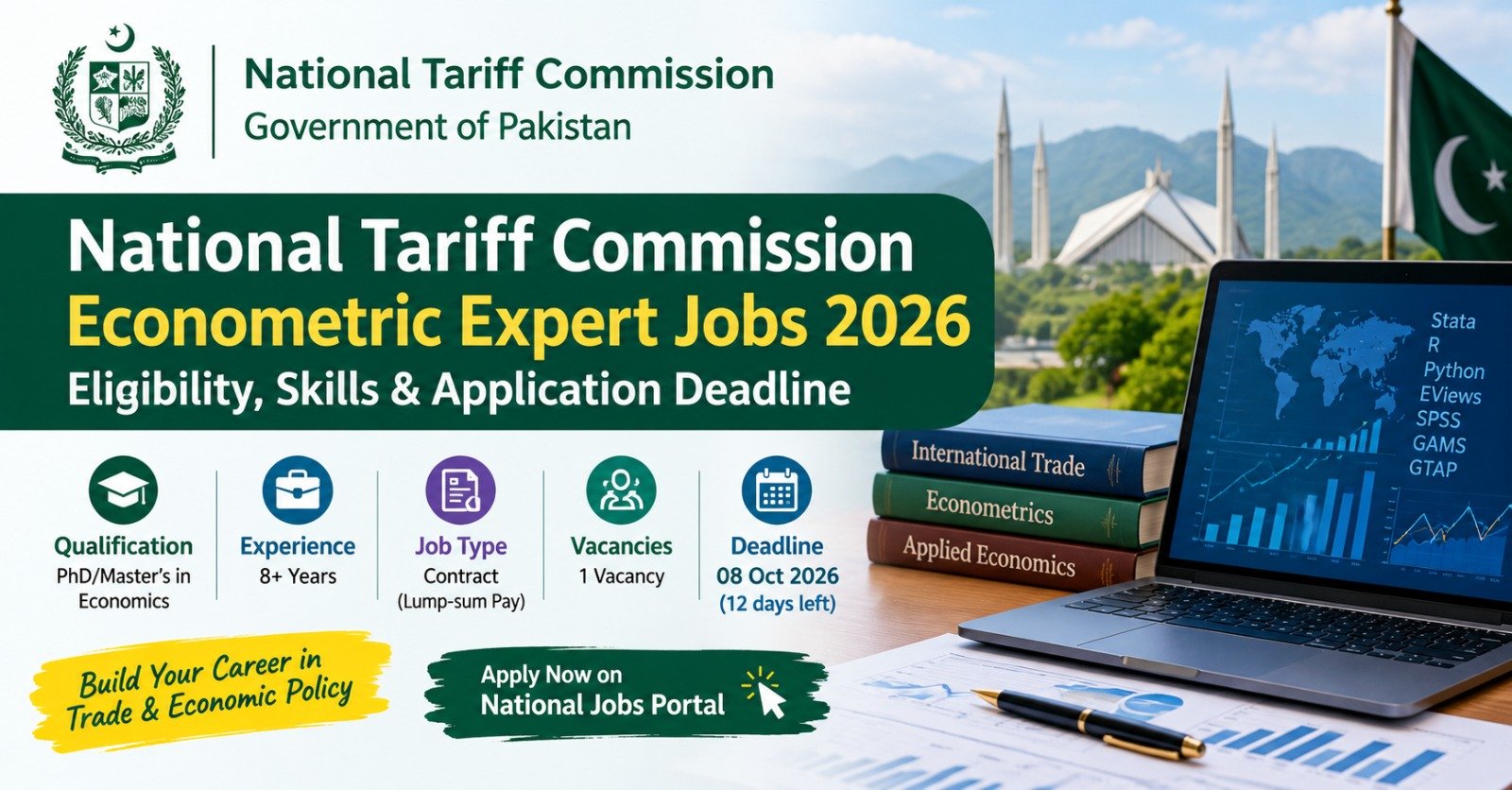
National Tariff Commission Econometric Expert Jobs 2026
The National Tariff Commission Econometric Expert Jobs 2026 provide a specialized government-sector opportunity for an experienced economics professional who has a strong background in applied economics, quantitative trade research, econometrics, tariff analysis, and economic modeling. The position has been advertised by the National Tariff Commission (NTC), Government of Pakistan, and is offered on a contract basis with the lump-sum pay.
According to the current National Jobs Portal listing, there is one vacancy for the position of an Econometric Expert / Economist, while the deadline of application is 08 October 2026. The position will requires a PhD, master’s degree, or equivalent qualification in the Economics, preferably with a specialization in the International Trade, Econometrics, or Applied Economics. Candidates also need at least an 8 years of relevant professional experience in areas such as the applied economics, quantitative trade research, tariff-change impact analysis, tariff analysis, or injury analysis which is related to the trade remedial measures.
This is therefore not a general entry-level economist position; as it is designed for a highly experienced professional who can contribute to quantitative economic analysis and trade-policy work. The vacancy have also emphasizes a technical proficiency in the Stata, R, Python or equivalent tools, together with an expertise in the Computed General Equilibrium modeling, with including the Global Trade Analysis Project and General Algebraic Modelling System, as well as Partial Equilibrium modeling.
Additional expertise in the EViews/SPSS, tariff optimization, export product development, sectoral competitiveness, value addition, productivity enhancement, consumer welfare and technology transfer is also mentioned in the official job description.
National Tariff Commission Econometric Expert Jobs 2026 – Overview
The position of a National Tariff Commission Econometric Expert / Economist is a specialized professional role within the Government of Pakistan’s National Tariff Commission. The official National Jobs Portal have identifies the employer as the National Tariff Commission and lists the type of job as Contract, with a lump-sum pay and one available vacancy. The advertisement was posted on 25 September 2026, and applications are scheduled to close on 08 October 2026.
The National Tariff Commission is a federal organization which is involved in a trade and tariff-related policy matters, with making this opportunity as particularly relevant for an economists whose professional experience is connected with the international trade, tariff structures, quantitative research and economic impact assessment.
The current employer listing on the National Jobs Portal have also identifies the National Tariff Commission in Islamabad and shows the role of an Econometric Expert / Economist in among its advertised positions. Because there is only one vacancy, applicants should carefully review the stated conditions of eligibility as before submitting an application.
The position is particularly suited to a professionals who can combine a theoretical economics with the practical quantitative analysis and who understand how tariff changes and trade measures can affect the industries, competitiveness, consumers and economic outcomes. Rather than treating this as a conventional economist vacancy, candidates should view it as a technical and analytical opportunity with requiring the substantial experience and advanced capabilities of modeling.
Applicants should also rely on the official National Jobs Portal listing for the latest information of application instead of depending on a copied job summaries from the third-party websites, especially because deadlines and details of vacancy can change after a publication.
Econometric Expert / Economist Job Details
Important Job Information at a Glance
The essential information for the vacancy can be summarized as follows: Organization: National Tariff Commission, Government of Pakistan; Position: Econometric Expert / Economist; Job Type: Contract; Pay: Lump-sum pay; Vacancies: 1; Experience: 8+ years; Posted: 25 September 2026; and Application Deadline: 08 October 2026. The official listing does not state a specific salary figure in the information which is available on the page of job, so applicants should not rely on an unofficial websites that are claiming a particular monthly or annual salary unless the Commission officially provides that information.
Similarly, the current listing have describes the role through its qualification, experience and skills that are mandatory rather than presenting it as a broad drive of recruitment. This distinction is important for an applicants because the opportunity is aimed at a narrow professional profile. Candidates with general economics qualifications but without substantial applied economics or trade-research experience may not meet the intended eligibility standard. The 8+ years of experience requirement is especially significant and should be considered alongside the technical requirements.
The ideal applicant would therefore likely have a professional history with involving a quantitative economic research, tariff policy analysis, trade-related modeling, impact assessment or closely related work. The role may be particularly attractive to a senior economists, econometricians, quantitative trade researchers and professionals who have worked on the tariff or trade-remedy questions.
Applicants should ensure that their CV clearly demonstrates a relevant experience rather than simply listing a degree in economics and general employment history. Where professional experience includes tariff analysis, quantitative modeling, trade research, injury analysis or sectoral competitiveness work, those areas should be clearly described in the application.
National Tariff Commission Econometric Expert Jobs 2026 Eligibility Criteria
The eligibility requirements for these Econometric Expert Jobs 2026 are specialized and should be reviewed carefully before application. The official National Jobs Portal states that candidates should hold a PhD/master’s degree or equivalent in Economics, with specialization in International Trade, Econometrics or Applied Economics. This educational requirement means that the vacancy is primarily intended for professionals with advanced academic training in economics rather than applicants from unrelated academic disciplines.
A candidate’s specialization can be particularly relevant because the position focuses heavily on quantitative trade research, tariff analysis and economic modeling. In addition to education, the position requires 8+ years of experience in relevant areas. The official description specifically mentions applied economics, quantitative trade research, impact analysis of tariff changes, tariff analysis and remedial-measure-related injury analysis. This means that simply having eight years of any professional experience may not necessarily demonstrate the relevant background expected for the position; applicants should be able to show how their experience relates to economics, trade, tariffs, quantitative analysis or associated research.
The vacancy also requires strong technical skills. Proficiency in Stata, R, Python or an equivalent tool is mandatory, while experience with Computed General Equilibrium and Partial Equilibrium modeling is also specifically required. Candidates should therefore evaluate their professional profile against both the academic and practical requirements. A strong application should make it easy for the recruiting organization to identify advanced economics education, relevant years of experience, quantitative research capability and direct familiarity with the modeling and software skills identified in the advertisement.
Educational Qualification
Required Economics Specialization
Candidates should have a PhD/master’s degree or equivalent in Economics, with the relevant specialization stated as International Trade, Econometrics or Applied Economics. These specializations will align closely with the responsibilities that are implied by the position because the role have requires an analysis of tariffs, trade measures and economic impacts. Applicants should make sure their academic qualifications are presented clearly in their CV and application, with including the level of degree, field of study and relevant specialization.
Professionals with academic research focused on international trade, applied econometrics, economic policy, tariff structures or related quantitative fields may be able to demonstrate a stronger connection to the role, provided their qualifications meet the official criteria. The qualification should not be treated in isolation, however, because the vacancy also places substantial emphasis on professional experience and technical modeling skills. A candidate with an advanced Economics degree but without the required level of relevant experience may not be an ideal match.
Conversely, extensive experience without the stated educational background may also fail to satisfy the advertised criteria. Therefore, prospective applicants should assess their complete profile against the official requirements as before applying. The best approach is to use the National Jobs Portal listing as the primary reference and ensure that all the information which is supplied in the application is accurate and verifiable.
Candidates should never exaggerate the academic credentials, professional experience or technical abilities because an inaccurate information can create problems in during the recruitment and may undermine an otherwise strong application.
Required Experience
Relevant Experience in Economics and Trade Research
The experience requirement is one of the most important aspects of the National Tariff Commission Econometric Expert Jobs 2026 vacancy. The official advertisement calls for 8+ years of experience in applied economics or quantitative trade research, including experience related to the impact analysis of tariff changes, tariff analysis, or injury analysis associated with remedial measures. This wording indicates that the Commission is seeking an experienced professional capable of handling complex economic questions rather than someone who is still developing basic analytical skills.
Relevant professional experience may include work which is involving a quantitative economic models, international trade research, tariff-policy assessment, economic impact studies, trade-remedy analysis or other closely related assignments. Applicants should therefore avoid presenting their experience only as a list of the job titles. Instead, their CV should explain the nature of the analytical work performed, the economic questions investigated and the tools or models that are used. For example, experience which is involving the tariff-change impact assessment, industry competitiveness studies, quantitative trade analysis or econometric research can be particularly relevant to the advertised position.
Candidates should also distinguish between general administrative experience and directly relevant economics or research experience. The goal should be to demonstrate that their previous professional work has prepared them to undertake sophisticated analysis for the National Tariff Commission. Because the vacancy is limited to one position, a clearly documented and relevant professional background can be especially important when applications are reviewed and shortlisted.
Skills Required for Econometric Expert / Economist Jobs
The technical skills listed in this vacancy make it substantially different from many general Economist Jobs in Pakistan 2026. The National Jobs Portal specifically identifies proficiency in Stata, R, Python or equivalent software as mandatory and also requires expertise in Computed General Equilibrium (CGE) and Partial Equilibrium modeling.
The description refers specifically to the Global Trade Analysis Project (GTAP) and the General Algebraic Modelling System (GAMS) in connection with CGE work, while also mentioning EViews/SPSS and a broad range of applied trade and economic analysis capabilities. These requirements suggest that the successful candidate needs to be comfortable working with economic datasets, quantitative models and software-based analysis rather than relying only on theoretical knowledge.
Stata, R and Python can be used for statistical analysis, data processing and econometric research, while EViews and SPSS are also established tools used in quantitative economic and statistical work. CGE and Partial Equilibrium models, meanwhile, can be applied to examine how changes in economic or trade conditions affect different sectors, markets and stakeholders.
The advertisement also lists tariff optimization, export product development, evaluation of sectoral competitiveness, value addition, productivity enhancement, consumer welfare and technology transfer. Applicants should therefore treat the skills section as a major eligibility consideration rather than an optional list of desirable abilities.
A candidate who has the required academic background and years of experience but lacks the mandatory quantitative and modeling skills may not be as competitive as someone who can demonstrate practical experience with these tools and approaches.
Econometric and Statistical Software Skills
Stata, R, Python, EViews and SPSS
Software proficiency is explicitly emphasized in the vacancy. The official listing requires mandatory proficiency in Stata, R, Python or an equivalent tool, while also identifying EViews/SPSS among the relevant technical capabilities. For an applicant, this means that simply mentioning software names on a CV may be less useful than explaining how those tools have been used in professional research.
A strong professional profile might demonstrate experience with statistical modeling, data cleaning, regression analysis, quantitative forecasting, trade datasets, economic impact assessment or other research tasks performed using relevant software. Candidates should be truthful about their level of skill and should not list the programs they have never used simply to match keywords. In a technical position such as this, the difference in between a basic familiarity and practical expertise can be significant.
Applicants should also consider how their experience in software connects to the economic problems as described in the advertisement of job. For example, a candidate who has used the Stata or R for international trade research, Python for an economic data analysis, or EViews for the econometric modeling can explain those applications in their professional history.
Similarly, experience with a statistical packages can be useful when conducting the sectoral analysis, assessing the impacts of tariff or evaluating productivity and competitiveness. The vacancy’s software requirements therefore reinforce the broader nature of the role: it is intended for an economist who can translate economic questions into quantitative analysis and communicate the resulting findings in a professional policy environment.
Economic Modeling Skills
CGE, GTAP, GAMS and Partial Equilibrium Modeling
The position specifically requires expertise in Computed General Equilibrium modeling, including the Global Trade Analysis Project (GTAP) and General Algebraic Modelling System (GAMS), as well as Partial Equilibrium modeling. These are advanced quantitative approaches that can be particularly relevant to trade and tariff analysis. A candidate with practical experience in these areas can potentially evaluate the effects of policy changes across sectors, markets and economic participants.
The important point for an applicants is that the advertisement is not merely asking for a knowledge of the economic theory; it is looking for the professionals who are capable of applying a quantitative frameworks to the real policy questions.
Experience with the CGE models can be relevant when analyzing a broader economy-wide effects, while Partial Equilibrium approaches can focus as more narrowly on a particular markets or sectors. GTAP and GAMS are specifically named in the official advertisement, so candidates who have actually worked with these systems should clearly mention their practical experience.
At the same time, applicants should not overstate their expertise as simply because they have completed an academic course which is involving these concepts. If a candidate has used these models in a thesis, research project, consulting assignment or professional policy study, the nature of that work should be described as accurately.
The combination of econometric software, trade modeling and applied economic research makes this vacancy particularly suitable for professionals who have worked at the intersection of economics, data and trade policy. It also explains why the experience requirement is set at eight or more years.
National Tariff Commission Economist Job Responsibilities
Although the current listing presents the role primarily through its qualification, experience and mandatory skills, the nature of the required expertise provides a clear indication of the analytical profile expected from an Econometric Expert / Economist. The candidate is expected to bring advanced capabilities in applied economics, quantitative trade research, tariff analysis and impact assessment.
The listed expertise in tariff optimization, export product development and evaluation of sectoral competitiveness points toward work that can support evidence-based assessment of trade and tariff issues. The additional focus on addition of value, productivity enhancement, consumer welfare and technology transfer have indicates that economic analysis may need to consider an effects as beyond the rates of tariff themselves.
For an example, trade policy decisions can influence the costs of production, domestic competitiveness, exports, consumer prices and incentives for an investment or adoption of technology. An experienced economist working in this environment needs to understand how quantitative evidence can be used to evaluate such effects. The requirement for injury analysis related to remedial measures is also significant because trade-remedy questions can involve detailed economic assessment of industries and markets.
Candidates with previous exposure to such research should make this experience prominent in their application. Rather than presenting themselves only as statisticians or data analysts, applicants should demonstrate an ability to connect quantitative findings with practical economic and trade-policy questions.
This combination of research, modeling and policy analysis is what makes the National Tariff Commission opportunity particularly relevant to senior economists and econometric experts with specialized trade experience.
Trade and Tariff Analysis Skills
Tariff Optimization, Competitiveness and Impact Analysis
The job advertisement lists several specialized areas, including tariff optimization, export product development, sectoral competitiveness, value addition, productivity enhancement, consumer welfare and technology transfer. These areas provide useful clues about the type of expertise candidates should highlight.
Tariff optimization involves examining tariff structures and their economic consequences, while sectoral competitiveness analysis can involve comparing the position of domestic industries within broader national and international markets.
Export product development may require an understanding of market opportunities, production capabilities and factors that influence export performance. Value addition and productivity enhancement are also important because trade competitiveness is not determined only by tariff rates; production efficiency, technology, inputs, market access and industrial capabilities can all influence outcomes.
Consumer welfare provides another perspective by considering how trade and tariff policies can affect prices, product availability and consumption. Technology transfer, meanwhile, can be relevant to long-term industrial development and productivity.
Applicants who have worked across these areas can demonstrate a broad understanding of applied economic policy. The key is to describe a genuine experience rather than simply inserting the keywords into a CV. The same principle will applies to the article itself: these terms are useful for helping the readers to understand the opportunity, but they should be included naturally and only where they accurately reflect the official vacancy. The current listing confirms these specialized skills, making them central to understanding the position.
How to Apply for National Tariff Commission Econometric Expert Jobs 2026
Candidates interested in the National Tariff Commission Econometric Expert Jobs 2026 should use the official National Jobs Portal listing as their primary source for application information. The vacancy is listed on the National Jobs Portal under the National Tariff Commission, Government of Pakistan, and the current listing have provides a route of an online application through the portal. Applicants should first review the complete job listing and confirm that their education, relevant experience and technical skills have match the advertised requirements.
The application should accurately reflect the candidate’s professional history, especially experience related to applied economics, quantitative trade research, tariff analysis, tariff-change impact assessment or remedial-measure-related injury analysis.
Candidates should also clearly present a relevant experience with the Stata, R, Python or equivalent software and, where it is applicable, CGE, GTAP, GAMS and Partial Equilibrium modeling. Since the position has only a one vacancy, applicants should avoid submitting a generic CV that does not demonstrate their suitability for the specialized role.
Instead, the application should make the relationship between previous professional work and the Commission’s requirements easy to understand. Candidates should also carefully review all information before submission and retain any application confirmation or relevant record provided by the portal. Most importantly, applicants should not rely on unofficial claims about the job’s requirements or deadline when the official listing is available. The National Jobs Portal currently gives 08 October 2026 as the deadline for application.
Important Instructions for Applicants
Applicants should complete the process of application as well before the date of closing rather than waiting until the final hours. Online portals can experience a technical issues, and candidates may also need time to prepare an accurate education and information of experience. Because the position have requires an advanced professional qualifications, applicants should ensure that their CV or application have clearly communicates the specific areas in which they have worked.
Experience should be described in a way that demonstrates a relevance to the vacancy without an exaggeration. Candidates should not claim an eight years of the relevant experience if their actual background does not meet that standard, nor should they claim an expertise in the GTAP, GAMS, Stata, R, Python or other technical tools without a genuine experience. Accuracy is particularly important for a recruitment in government because a professional qualifications and experience may be subject to the verification.
The official National Jobs Portal is the appropriate place to confirm the active status and process of application for the vacancy. Applicants should also remember that the listing describes the position as a contract role with lump-sum pay, rather than a permanent appointment. The available information does not provide a specific amount of salary, so candidates should avoid assuming or publishing an unverified figure of salary.
The deadline is also a fixed date in the current listing: 08 October 2026. Anyone who is interested in applying should therefore verify the listing as immediately before a submission in case the recruiting authority publishes an update or additional instruction.
National Tariff Commission Jobs 2026 Last Date
The last date to apply for National Tariff Commission Econometric Expert Jobs 2026 is 08 October 2026, as according to the current National Jobs Portal listing. The position was posted on 25 September 2026, with one vacancy and an requirement of experience of 8+ years. This deadline should be treated as an important part of the process of application because a late submissions may not be considered.
Candidates should not wait until the final day if they already meet the criteria of eligibility. Instead, they can use the available time to review their educational information, history of employment and technical skills as before submitting an application through the official portal.
The deadline is also an important fact for anyone who is publishing an information about this vacancy because job seekers depend on an accurate dates when deciding whether they can apply. For that reason, articles and social posts about the vacancy should avoid creating the artificial urgency such as claiming that applications are closing within a hours unless that statement is actually supported by the current official information.
The correct approach is simply to state the official deadline and encourage an eligible candidates to check the official portal as before applying. As the National Jobs Portal is the primary listing for this government vacancy, applicants should verify the current status there rather than relying as solely on a third-party job websites.
What Applicants Should Do Before the Deadline
Before submitting an application, candidates should compare their profile against every major requirement in the official listing. They should confirm that they hold the required advanced Economics qualification, have at least eight years of relevant professional experience and possess the mandatory quantitative and modeling skills described by the Commission. It is particularly useful to identify concrete examples of previous work involving tariff analysis, quantitative trade research, economic impact analysis or trade-remedy-related injury assessment.
Candidates should also prepare a clear evidence of their software and capabilities of modeling, especially where their experience includes the Stata, R, Python, EViews, SPSS, GTAP, GAMS, CGE or models of a Partial Equilibrium. If their previous roles that have involved the sectoral competitiveness, export development, productivity, consumer welfare, addition of value or transfer of technology, these areas can also be highlighted because they directly correspond to skills as mentioned in the vacancy.
Applicants should review their CV for a consistency and make sure that the dates, qualifications and responsibilities of job are accurate. They should also avoid an unnecessary information that have makes it as difficult for a recruiter to identify the most relevant experience.
Since there is only one vacancy, a focused and accurate application can be more useful than a long application that does not clearly demonstrate the suitability. Finally, applicants should submit through the official channel of application and keep a record of their submission. The National Jobs Portal have currently identifies the deadline as 08 October 2026, but applicants should always check the official listing for the latest status before submitting.

Why This Econometric Expert / Economist Opportunity Matters
The National Tariff Commission opportunity stands out because it combines economics, econometrics, international trade, tariff policy and advanced quantitative modeling in a single professional role. Many vacancies of economist have focus as primarily on a research, reporting or general economic analysis, whereas this position have specifically identifies a trade-related research, tariff-change impact analysis and remedial-measure-related injury analysis as a relevant experience. It also asks for the practical familiarity with a several analytical tools and frameworks of modeling, which is making it as particularly relevant to a professionals who have built a careers in the quantitative economics.
The focus on optimization of tariff, development of an export product, sectoral competitiveness, productivity, consumer welfare and technology transfer have further connects the role to a practical economic-policy questions. For an experienced economists, such a position can provide an opportunity to apply the quantitative knowledge to issues that affect the trade and industry.
However, candidates should assess the opportunity as realistically. This is not a general graduate vacancy, and the requirement for an 8+ years of the relevant experience means that early-career applicants are unlikely to match the stated profile. The position is more appropriate for a professionals who have already developed a substantial experience in the applied economics, quantitative trade research or closely related fields.
Candidates should also understand that the advertisement specifies an appointment of contract and lump-sum pay. Because the listing have contains one vacancy, competition may be significant in among the applicants who meet the advanced requirements. A well-prepared, truthful and technically focused application is therefore important.
Apply now: Econometric Expert / Economist
Who May Be a Good Fit for This Position
A strong potential applicant would generally be an experienced economics professional with an advanced degree and a substantial background in applied or quantitative economic research. Someone who has worked extensively on international trade, econometrics, tariff analysis or trade-remedy issues may find the vacancy particularly relevant. Professionals who can demonstrate practical experience with Stata, R, Python, EViews or SPSS, along with advanced economic modeling such as CGE, GTAP, GAMS and Partial Equilibrium approaches, should pay close attention to the opportunity.
Experience in optimization of tariff, export product development, sectoral competitiveness, addition of value, productivity enhancement, consumer welfare or transfer of technology can further align the background of an applicants with the stated requirements. The most suitable candidate is therefore likely to be someone who can move as comfortably in between the economic theory, quantitative data, statistical software and real-world trade-policy analysis.
Applicants should not assume that possessing a degree alone makes them eligible because the experience and technical requirements are substantial. Similarly, having an extensive experience in the economics without a relevant trade or quantitative exposure may not provide the same alignment as a background which is directly connected to the advertised fields.
Candidates should read the official vacancy as carefully and evaluate each requirement as before applying. The National Jobs Portal listing have remains the best reference for the current details and deadline of vacancy.
Also Read: Ignite Assistant Manager Collaboration Jobs 2026 – Eligibility, Qualification & Application Details
Frequently Asked Questions About Econometric Expert Jobs 2026
What is the qualification for National Tariff Commission Econometric Expert Jobs 2026?
The official listing requires a PhD/master’s degree or equivalent in Economics, with specialization in International Trade, Econometrics or Applied Economics.
Is a PhD required for this position?
The listing allows a PhD/master’s degree or equivalent in Economics, so the published requirement is not limited exclusively to PhD holders. Candidates should, however, meet the specified specialization and experience requirements.
How much experience is required?
The position requires 8+ years of relevant experience. The official description identifies applied economics, quantitative trade research, tariff-change impact analysis, tariff analysis and remedial-measure-related injury analysis among the relevant areas.
What type of experience is relevant?
Experience directly connected with applied economics, quantitative trade research, tariff analysis, economic impact assessment or related trade-remedy injury analysis is particularly aligned with the published requirements. Candidates should demonstrate the relevance of their professional work rather than simply counting total years of employment.
What software skills are required?
The advertisement identifies mandatory proficiency in Stata, R, Python or equivalent, and also mentions EViews/SPSS among the required technical capabilities.
Is Stata, R or Python experience required?
Yes. The official job description specifically describes proficiency in Stata, R, Python or equivalent as mandatory.
What modeling expertise is required?
Candidates should have expertise in Computed General Equilibrium modeling, including GTAP/GAMS, as well as Partial Equilibrium modeling.
What is the last date to apply?
The current National Jobs Portal listing gives 08 October 2026 as the application deadline.
How many vacancies are available?
There is one vacancy for the Econometric Expert / Economist position.
What is the job type?
The vacancy is advertised as a contract position with lump-sum pay.
Final Thoughts on National Tariff Commission Econometric Expert Jobs 2026
The National Tariff Commission Econometric Expert Jobs 2026 represent a highly specialized opportunity for experienced economics professionals who possess strong quantitative, econometric and international-trade expertise. The position combines an advanced Economics qualification requirement with at least 8 years of relevant experience and substantial technical expectations involving Stata, R, Python or equivalent tools, CGE modeling, GTAP, GAMS, Partial Equilibrium modeling and other areas of economic analysis.
The additional focus on optimization of tariff, development of an export product, sectoral competitiveness, value addition, enhancement of productivity, consumer welfare and transfer of technology have makes this role as particularly relevant to a professionals whose careers have involved the trade and economic policy research.
There is one contract vacancy, and the current official deadline is 08 October 2026. Candidates who meet the stated requirements should review the official National Jobs Portal listing as carefully and submit an accurate information through the designated channel of application. They should also avoid as relying on the unverified figures of salary, altered deadlines or copied descriptions of job from an unofficial sources.
Most importantly, applicants should honestly assess whether their academic background, professional experience and technical skills have correspond to the requirements as before applying. For qualified economists and econometric experts with strong trade-policy experience, this vacancy may be a relevant professional opportunity within the Government of Pakistan’s National Tariff Commission.
The official listing should remain the final authority for application instructions, eligibility details and any updates before the deadline.
1 thought on “National Tariff Commission Econometric Expert Jobs 2026 – Eligibility, Skills & Application Deadline”